



When my doctor first advised me to exercise more to manage my Type 2 diabetes, I pictured sweat-drenched gym sessions and grueling cardio. That approach spiked my stress levels, left my joints aching, and made consistency impossible. What actually helped bring my A1C down from 7.8% to 6.1% was something much quieter.
Research suggests that how we move matters just as much as how hard we move. For those of us managing metabolic health, intense physical stress can sometimes trigger a cortisol response that temporarily raises blood sugar. Shifting focus to mindful movement for diabetes allows you to build strength and sensitize your cells to insulin without flooding your system with stress hormones.

Jump to the 7 mindful movement secrets
Always consult your physician before starting any new exercise program, especially if you take insulin or medications that can cause low blood sugar. The strategies below are based on research and what worked for my own routine, but your medical team knows your specific needs best.
1. The 10-Minute Post-Meal Walk
The most effective movement often requires the least equipment. Walking is a cornerstone of gentle exercise for diabetic women because it directly intercepts the glucose spike that follows a meal.
Step outside for a ten-minute walk within twenty minutes of finishing your last bite. Contracting muscles pull glucose straight from your bloodstream to use for energy without waiting for insulin to do the job. This mechanical process helps blunt the sharp blood sugar peaks that often happen after eating carbohydrates.
You do not need to power walk or break a sweat. A comfortable, steady pace around the block or even pacing in your house is enough to activate those larger leg muscles. I usually use this time to listen to an audiobook, making it a mental break rather than a fitness chore.
2. Sync Your Breath to Gentle Stretches
Stretching feels good, but combining it with intentional breathing turns a simple physical action into a powerful tool for mindfulness for diabetes management. When you focus on your breath, you signal your nervous system to shift out of a stressed state.
Exhale twice as long as you inhale during a stretch to actively lower your heart rate. For example, breathe in for three seconds as you reach your arms up, and exhale for six seconds as you fold forward. This extended exhalation can support vagal activity, which helps calm the body. Chronically elevated cortisol is linked with insulin resistance, so finding ways to reliably relax your body has a tangible metabolic benefit.
3. Try Floor-Based Resistance Work
Building muscle is vital because muscle tissue acts as a storage sink for extra glucose. However, lifting heavy weights while standing can put unnecessary pressure on your knees and lower back. Taking the movement to the floor removes the balance requirement and protects your joints.
Keep your back fully supported on the floor while doing glute bridges or chest presses. Lie flat on a yoga mat with your knees bent and feet flat. Squeeze your glutes to lift your hips toward the ceiling, hold for a second, and slowly lower down. If you want to work your upper body, stay on your back and press light dumbbells or two water bottles straight up over your chest. Aim for two sets of ten to twelve repetitions to build strength safely without challenging your balance.

4. Plan Around Your Blood Sugar Curve
Many women avoid starting a routine because they worry about their blood sugar dropping unexpectedly. This fear is valid, and pretending it does not exist makes it harder to build a habit. The trick is timing your movement to your body's natural daily rhythm.
Check your levels fifteen minutes before starting any structured routine and follow the safe range your care team has given you. If your blood sugar is trending downward or sitting at 100 mg/dL or lower, start with 15–20 grams of fast-acting carbohydrate, then ask your care team whether a steadier snack makes sense for longer routines. I usually keep a small handful of almonds and a few apple slices on the kitchen counter if I plan to do resistance work.
5. Turn Chores Into Mindful Movement
Not all beneficial activity happens on a yoga mat. Daily tasks account for a massive portion of our overall energy expenditure. Shifting your mindset turns mundane chores into low impact exercise for diabetes.
Treat carrying groceries or lifting a laundry basket as a focused muscle exercise. Instead of just rushing to get the basket up the stairs, brace your core, keep your spine straight, and lift with your legs. Paying attention to how your muscles engage during these daily tasks increases your physical awareness and adds small pockets of resistance training to your day without requiring extra time.
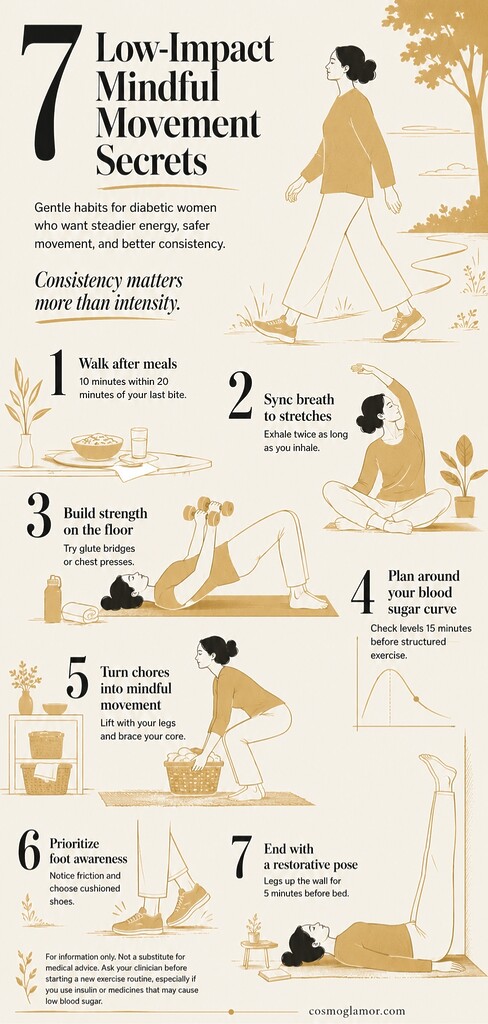
6. Prioritize Foot Awareness
This is the quietest secret on the list, but arguably the most critical for diabetic women. Movement is only healthy if it remains safe, and our feet bear the brunt of the impact.
Scan your feet mentally while moving and check them physically afterward for any signs of friction. Diabetes can cause peripheral neuropathy, making it harder to feel a blister or a pressure point forming in a shoe. Never push through foot pain. Investing in supportive, well-cushioned shoes and seamless socks is a non-negotiable part of this process.
7. Use Restorative Poses to Lower Cortisol
Ending your day with a restorative practice sets your body up for a better night of sleep. Poor sleep directly impairs insulin sensitivity the next day, creating a frustrating cycle of high blood sugar.
Pushing through pain is not a badge of honor; for a diabetic body, it is a cortisol trap.
Lie with your legs elevated against a wall for five minutes before bed to encourage circulation. Scoot your hips close to the baseboard, extend your legs up the wall, and rest your arms comfortably at your sides. This gentle inversion helps drain accumulated fluid from your ankles and signals your nervous system that it is time to rest. It is a completely passive movement that delivers profound physical relief.

Frequently Asked Questions
What should I do if I feel dizzy or shaky while moving?
Stop immediately and sit down. Shakiness, dizziness, or sudden sweating can be signs of hypoglycemia (low blood sugar). Check your glucose levels if you have a monitor, and always keep a fast-acting carbohydrate nearby, like a small juice box or glucose tablets, just in case.
How often should I practice mindful movement?
Consistency matters more than duration. Aiming for fifteen to twenty minutes of gentle, intentional movement most days of the week is far better than attempting a grueling hour-long session once a week and then needing days to recover.
Can I still do these exercises if I have joint pain?
Yes, but modifications are essential. If standing is painful, many stretches and resistance exercises can be adapted to a seated position in a sturdy chair. The goal is gentle activation, not discomfort.
Finding a routine that fits your life takes patience, but learning to move in a way that respects your body's limits gives you back your energy.
Sources
- Advice to walk after meals – Diabetologia, 2016.
- Blood Glucose and Exercise – American Diabetes Association, n.d.
- Deep and slow breathing – Scientific Reports, 2021.
- Insulin in skeletal muscle – Cell Metabolism, 2021.
- Diabetic footwear guideline – Journal of Foot and Ankle Research, 2018.
- Partial sleep deprivation and insulin resistance – Journal of Clinical Endocrinology & Metabolism, 2010.
- Cortisol dysregulation and type 2 diabetes – Annals of the New York Academy of Sciences, 2017.