





You do not need a two-hour morning routine to stop feeling constantly behind. When your schedule is packed tight, elaborate self-care just becomes another chore to fail at. Building effective daily habits for stress relief means dropping small, deliberate anchors right into the middle of your chaos.

Stop Trying to Escape Your Life
We often treat stress like a location we can just drive away from. We assume we will finally relax once the weekend hits, the kids are in bed, or that vacation rolls around. But waiting for empty time to feel calm leaves you at the mercy of your schedule.
Real stress management does not require you to abandon your responsibilities. It requires you to change how your nervous system responds to them.
Lowering my blood pressure from 145/95 to a consistent 120/80 did not happen because I moved to a quiet cabin. It happened when I stopped letting my inbox and my family's endless logistics dictate my heart rate. You have to train your body to find a baseline of calm while the noise is still happening.
These are the three simple stress management habits that actually moved the needle for me. They cost nothing, they require zero equipment, and you can start them today.
1. The Ten-Minute Information Fast

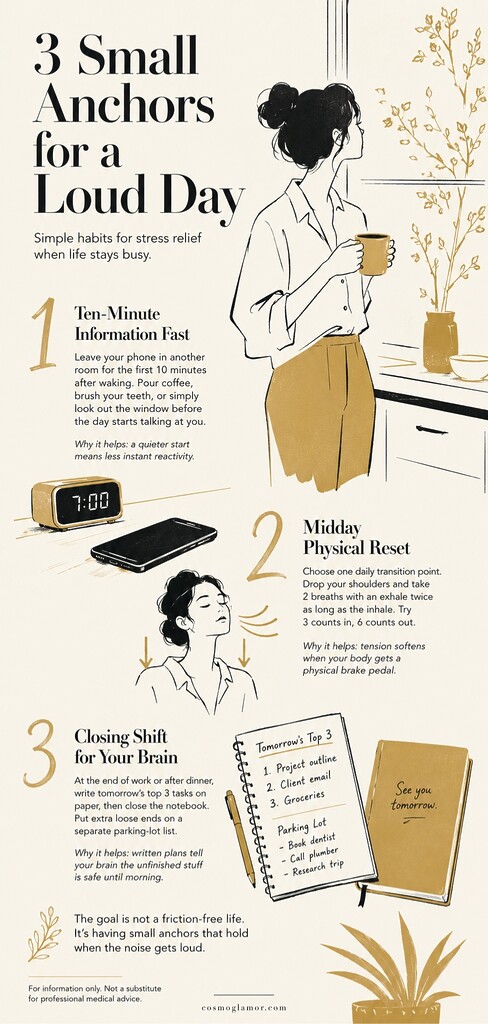
Leave your phone plugged in another room until you have poured your coffee or brushed your teeth. Give yourself a strict ten-minute buffer between waking up and consuming the world's demands. If you currently rely on your phone as an alarm, spend ten dollars on a basic digital clock for your nightstand.
Most of us grab our phones before our eyes are fully adjusted to the light. Your cortisol is already rising naturally after you wake, and research on phone use suggests digital input can add another stress signal before your body has finished that waking cycle. Delaying digital input gives you a quieter start so you begin the day reacting to your own needs rather than someone else's emergencies.
This is the cornerstone of a calming daily routine. You do not have to meditate or write in a journal. Just look at the wall, pet your dog, or watch the coffee brew. Let your brain wake up empty.
2. The Midday Physical Reset
Pick a daily transition point. It could be waiting in the school pickup line, closing your laptop for lunch, or stepping out of your car. When you hit that marker, drop your shoulders physically and take two breaths where the exhale is twice as long as the inhale. Try inhaling for a count of three, and exhaling slowly for a count of six.
We carry mental overwhelm as physical tension, usually locking our shoulders near our ears without noticing. Extending your exhale to be longer than your inhale may help stimulate the vagus nerve, which acts as a physical brake pedal for your autonomic nervous system.
Tying this breath to a specific physical threshold builds an automatic trigger. You stop relying on willpower to remember to relax. Your body simply learns that closing the laptop means dropping the tension.
3. The “Closing Shift” for Your Brain

At the end of your workday or right after dinner, take a blank piece of paper. Write down the top three things you need to handle tomorrow, then physically close the notebook. If you have a dozen other minor tasks swirling around, dump them onto a secondary “parking lot” list, but keep tomorrow's strict top three isolated on their own page.
The human mind is wired to fixate on unfinished tasks to ensure we do not forget them. Writing them down acts as a psychological receipt, giving your brain permission to stop tracking those loose ends until morning. You are proving to your nervous system that the information is safe.
If you skip this, your brain will spend the hours between 9:00 PM and midnight trying to remind you to buy laundry detergent and email your boss. These calming daily habits only work if you actively construct boundaries between your working hours and your resting hours.
Common Friction Points
What if my days are entirely unpredictable?
Unpredictable days are exactly why you need small anchors. If a rigid schedule falls apart, these three habits survive because they take minutes. You can do a long exhale in a hospital waiting room just as easily as you can in your living room.
How long does it take to feel a difference?
You will likely feel the edge come off immediately after the breathing reset. However, the compound effect of waking up with less digital stress and going to sleep with fewer loose ends may take longer to feel obvious.
The goal is not to engineer a life with zero friction. You will still have chaotic mornings and stressful afternoons. But dropping these small anchors ensures you remain in the driver's seat when the noise gets loud.
Sources
- Technology Use, Cortisol, and Inflammation — Computers in Human Behavior, 2018.
- Breath of Life — Frontiers in Human Neuroscience, 2018.
- Plan Making and Unfulfilled Goals — Journal of Personality and Social Psychology, 2011.
- The Cortisol Awakening Response — Frontiers in Neuroscience, 2022.