





If your neck is constantly screaming at you, the actual problem is probably sitting a few inches lower. When I was trying to figure out my own chronic back pain a few years ago, I realized I was just massaging the symptoms. To actually fix the deep tension, I had to stop stretching my neck and start waking up my upper back. That is why doing specific shoulder blade exercises for neck pain is often the turning point for recovery.

The Anchor and the Sail
Think of your neck as a sail and your shoulder blades as the anchor holding it in place. Most of us spend our days hunched over keyboards and phones. Over time, the muscles between our shoulder blades get weak and overstretched. They lose their grip. When the anchor slips, the sail takes all the wind. Your small neck muscles end up doing the heavy lifting to keep your head upright, which is exactly why they feel so tight and exhausted by 4:00 PM.
You cannot stretch a weak muscle into being strong. You have to rebuild the foundation.
These are the upper back pain exercises that helped me rebuild mine. They do not require weights, and you can do most of them in your pajamas. Before we get into the movements, a quick reminder: always consult your physician before starting any new exercise program, especially if you are dealing with sharp or radiating pain.
The 6 Best Neck and Shoulder Pain Exercises
1. The Doorway Chest Opener
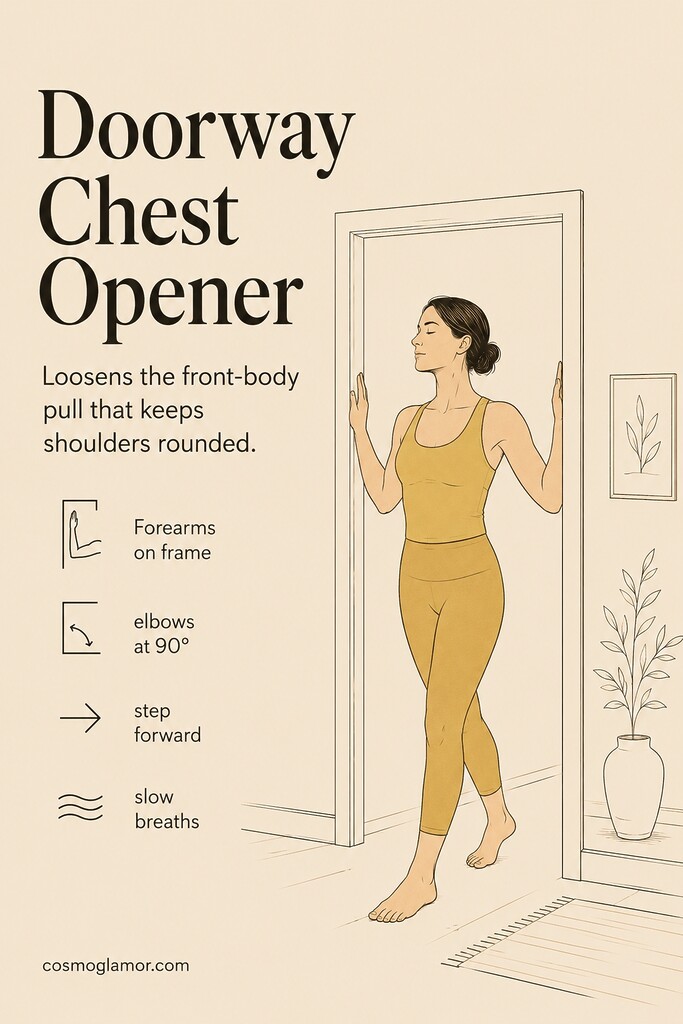
It sounds strange to start a back routine by stretching your chest. But your pectoral muscles pull your shoulders forward when they get tight. If you try to strengthen your back while your chest is locked up, you are just fighting yourself. Opening the front of your body gives your shoulder blades the slack they need to retract properly.
Stand in a doorway and place your forearms flat against the doorframe on each side. Your elbows should be bent at a 90-degree angle. Gently step one foot forward through the doorway until you feel a pull across your chest and the front of your shoulders. Hold that position and take five deep, slow breaths. Then switch your feet and repeat.
2. Scapular Squeezes
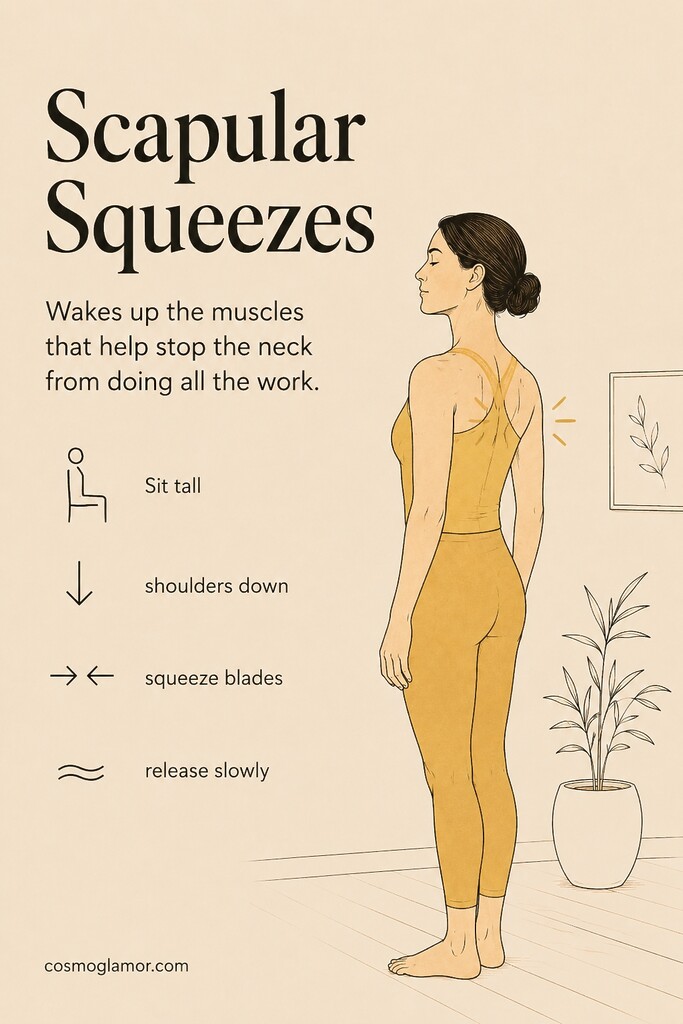
This is the absolute baseline. It teaches your brain how to find your rhomboids again. The rhomboids are the muscles that pull your shoulder blades together, and waking them up helps keep your shoulders from dragging your neck forward.
Sit or stand tall. Let your arms hang loosely at your sides. Without shrugging your shoulders up toward your ears, pinch your shoulder blades together as if you are trying to hold a pencil between them. Hold that hard squeeze for three seconds. Release slowly. Do this 10 to 15 times.
A common mistake here is letting the shoulders creep up. Keep them pulled down away from your ears the entire time.
3. Wall Angels
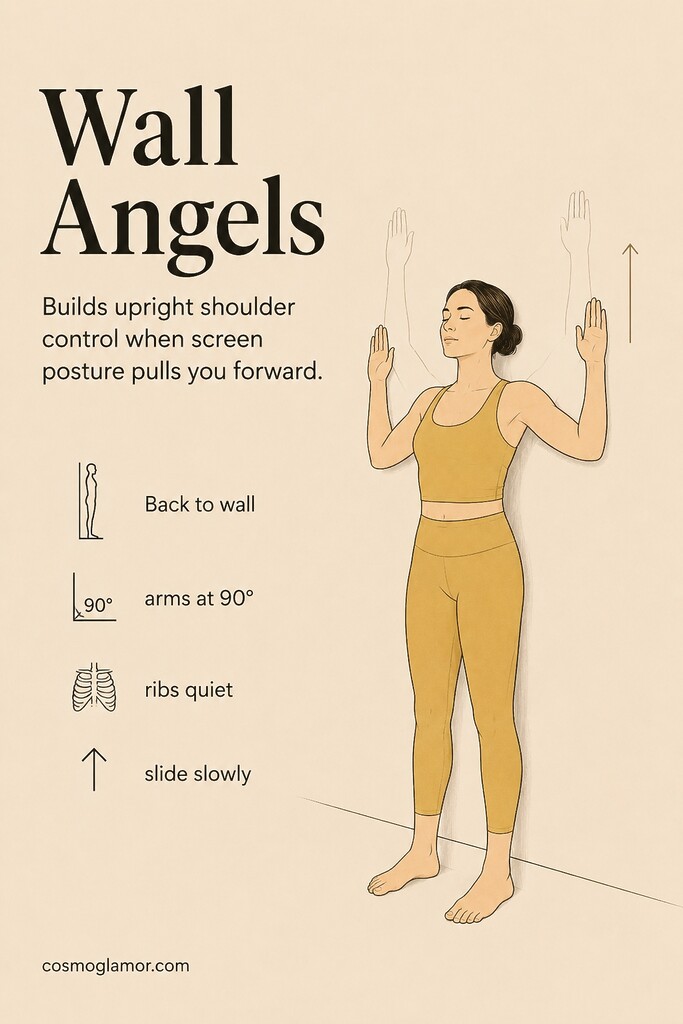
You might feel a satisfying stretch here, or you might barely be able to keep your arms against the wall. Both are completely fine. Wall angels force your upper spine into an upright position while engaging the muscles that stabilize your shoulders.
Stand with your back against a blank wall. Step your feet about six inches away from the baseboard. Press your tailbone, upper back, and the back of your head flat against the wall. Raise your arms up to 90 degrees so the backs of your elbows and hands are touching the drywall. Slowly slide your arms up toward the ceiling as high as you can without letting your lower back arch away from the wall. Slide them back down. Try for 10 slow repetitions.
4. Prone Ys and Ts
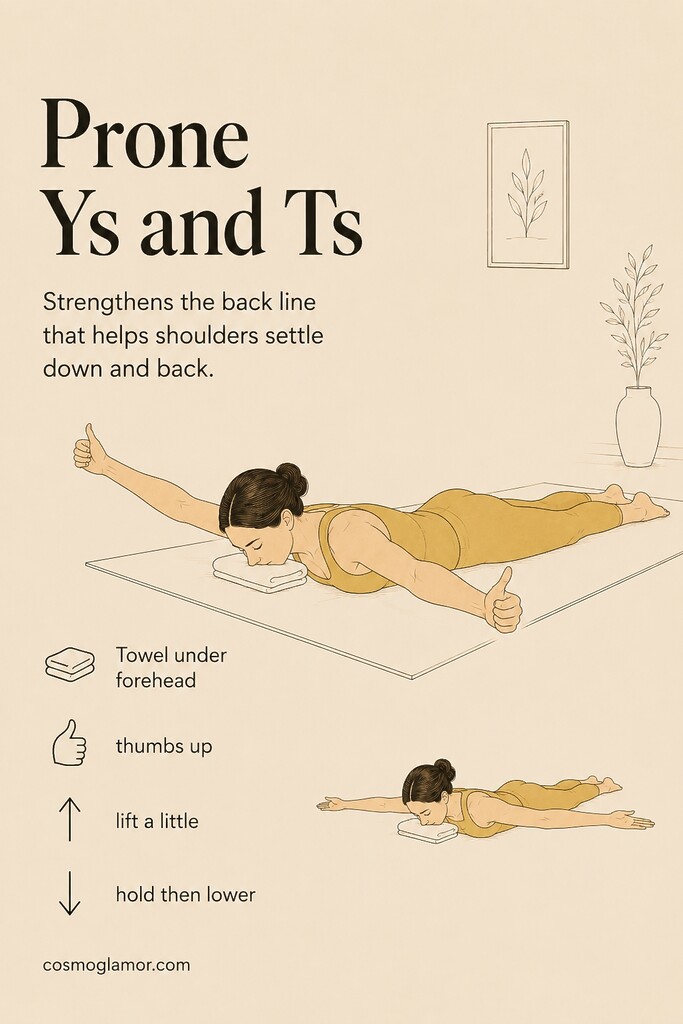
This movement isolates the lower and middle trapezius muscles. These are the unsung heroes of upper body posture. When they are strong, they naturally pull your shoulders down and back.
Lie face down on a comfortable rug or yoga mat. Roll up a small hand towel and place it under your forehead so you can keep your neck neutral and still breathe. Extend your arms out in front of you in a “Y” shape with your thumbs pointing up at the ceiling. Squeeze your shoulder blades to lift your arms a few inches off the floor. Hold for two seconds, then lower. Do 8 reps.
Next, move your arms straight out to the sides to form a “T” shape. Lift, squeeze the blades together, hold, and lower. Do 8 reps of the T shape.
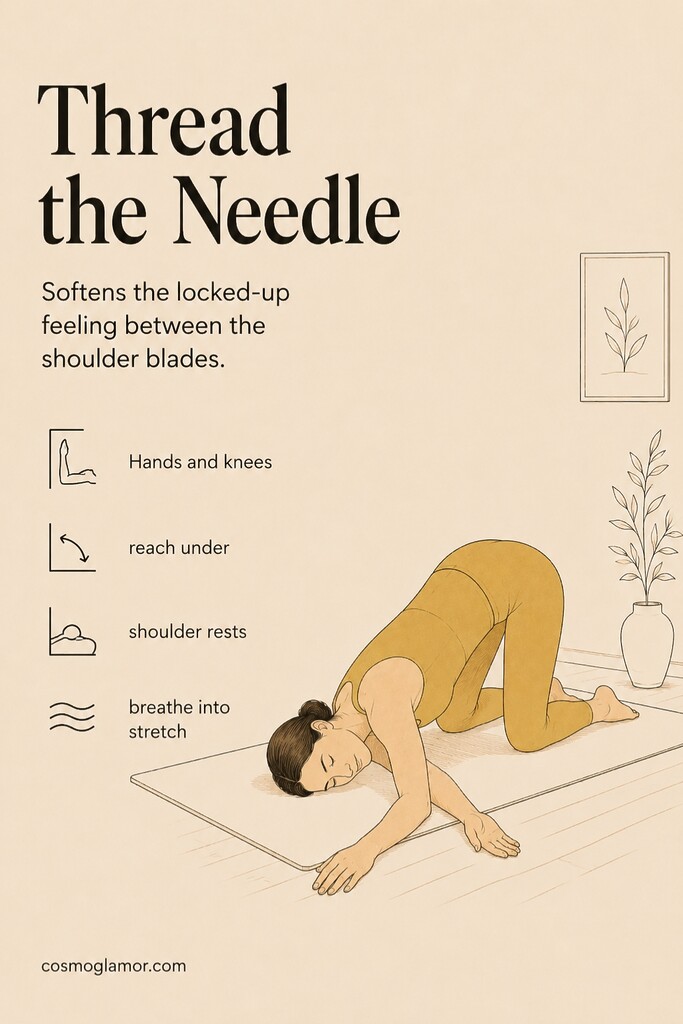
5. Thread the Needle
Sometimes the area between your shoulder blades feels like a solid block of concrete. Thread the needle introduces gentle rotation to your thoracic spine. Adding mobility to this stiff area can help your cervical spine move more comfortably, which is just the part of your spine running through your neck.
Start on your hands and knees. Take your right arm and slide it underneath your left arm, reaching as far to the left as you comfortably can. Let your right shoulder and the side of your head rest gently on the floor. Take three deep breaths into the stretch. Push back up to the starting position and repeat on the other side. Do this twice per side.
6. The Desk-Side Shrug and Roll
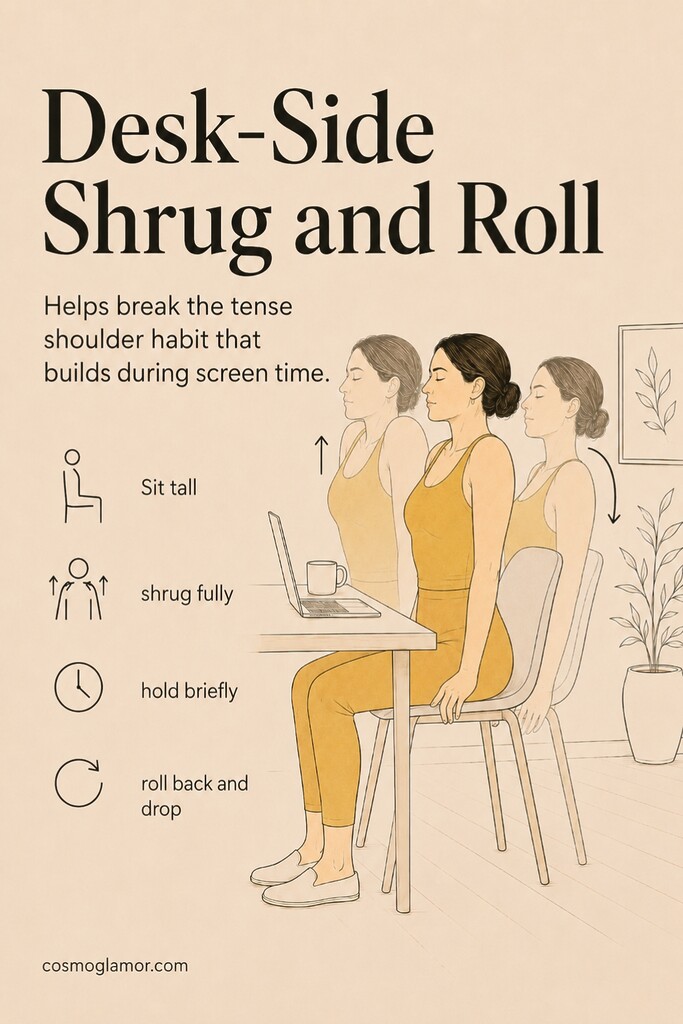
You can do this one while reading an email. We hold an unbelievable amount of stress in our upper traps. Giving those muscles permission to contract fully actually helps them release afterward.
Sit up straight. Shrug both shoulders up to your ears as tightly as you can. Hold that tension for five full seconds. Now, roll your shoulders backward, pull your shoulder blades together, and let them drop down into a relaxed position. Repeat this cycle three times. It breaks the chronic, low-level shrugging habit we all develop when staring at screens.
Consistency Over Intensity
When you are trying to convince small, tired muscles to do their job again, aggression does not work. Doing fifty aggressive reps today will just leave your neck throbbing tomorrow. Try running through this short sequence once a day. It takes a little time for these dormant muscles to wake up and take the burden off your neck. Stay patient, keep your movements controlled, and give your body the consistency it needs to heal.
Sources
- Exercises for mechanical neck disorders – Cochrane, 2015.
- Scapular kinematics and pectoralis minor stiffness – Journal of Shoulder and Elbow Surgery, 2018.
- Chronic neck pain and scapular dyskinesia – BMC Musculoskeletal Disorders, 2025.
- Thoracic spine manipulation vs mobility exercises – Medical Science Monitor, 2022.