

The biggest myth about mindfulness is that you have to completely empty your mind. If you are a busy person with a loud brain, that sounds impossible. The goal is never a blank slate; it is just learning how to sit comfortably with the noise.

Jump to the 7 beginner techniques
Figuring out how to meditate for beginners usually comes down to finding the right anchor. Some people need a visual focus, while others need to move their bodies. Trying to force yourself into a style that does not fit your personality is why so many people quit on day three.
If sitting in silence feels maddening, you are completely normal. You just need a different approach.
Where to Start: 7 Accessible Meditation Styles
You do not need an hour, and you do not need a special cushion. You just need a few minutes and a willingness to try.
1. Guided Meditation (The Easiest Entry Point)
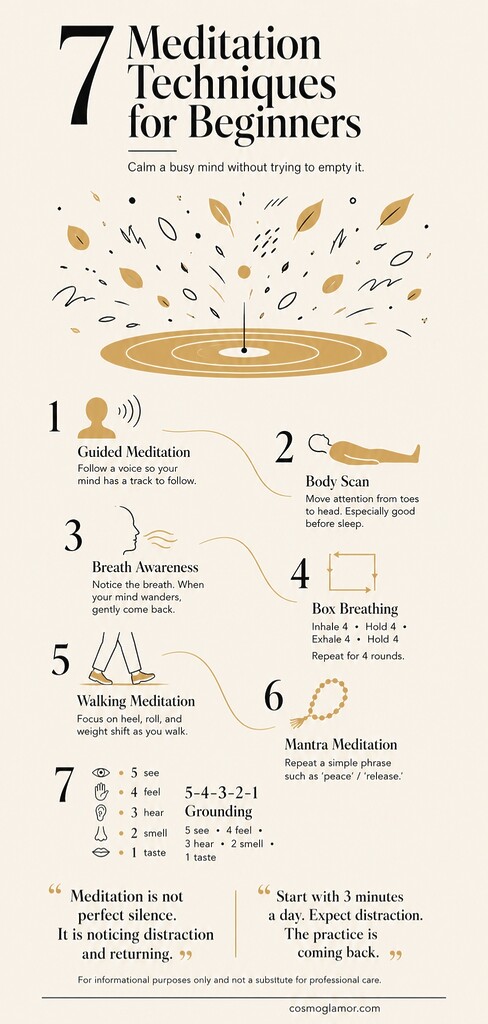
If you have never meditated before, do not try to sit in silence. Trying to steer your own brain on day one is setting yourself up for frustration. Guided meditation for beginners involves listening to an instructor who tells you exactly what to do, what to focus on, and when to bring your attention back.
Having a voice guide the session removes the pressure of doing it “right” and gives your brain a specific track to follow. You can find thousands of free options on YouTube or through apps like Insight Timer and Calm. Search specifically for “5-minute guided meditation without music” so you aren't fighting distracting background sounds. Sit in any normal chair with your feet flat on the floor, hit play, and just follow the prompts.
2. The Body Scan (Best for Sleep)
When you carry stress, your body often physically tenses up before your brain even registers the anxiety. A body scan is a systematic way to check in with those physical signals.
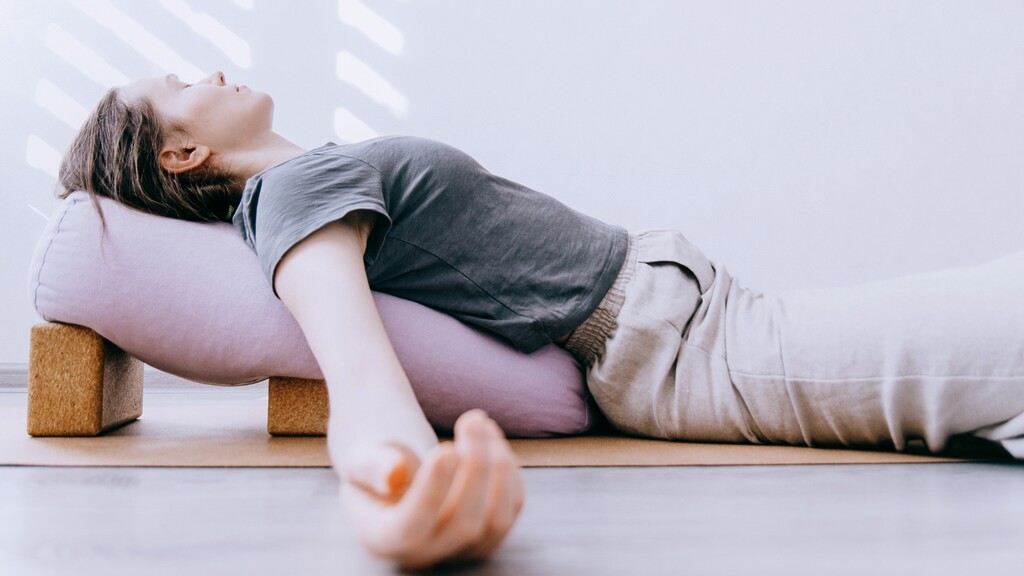
Lie on your back or sit comfortably with your hands resting by your sides. Mentally bring your attention to your toes. Spend two full, slow breaths just noticing how they feel, release any tension you are holding there, and then move your focus up to your ankles. Work your way up your calves, knees, and torso, all the way to the top of your head. Deliberately relaxing your muscles in sequence can ease physical tension and may improve sleep quality, which makes this a useful option right before bed.
3. Breath Awareness (The Classic Anchor)
This is what most people picture when they think of mindfulness meditation for beginners. You sit quietly and pay attention to the physical sensation of your breath.
Sit wherever you are comfortable. You can close your eyes, or if that makes you feel anxious, just let your gaze rest on a spot on the floor a few feet in front of you. Notice the cool air entering your nose and the warm air leaving. When your mind inevitably wanders, just notice the thought and bring your focus back to the breath. You do not need to alter how deeply you are breathing. You are simply observing the automatic process that is already happening.
4. Box Breathing (The Nervous System Reset)
If you are actively overwhelmed or anxious, passive breathing might not be enough to grab your attention. Box breathing is a structured breathing meditation for beginners that requires counting, which gives your analytical brain a job to do.
Use a simple 4-part rhythm:
- Inhale slowly for 4 seconds.
- Hold your breath at the top for 4 seconds.
- Exhale completely for 4 seconds.
- Hold your lungs empty for 4 seconds.
Repeat this square cycle four times. Regulating your breath in a slow, steady pattern can support your parasympathetic nervous system, which helps your body shift away from a fight-or-flight state.
5. Walking Meditation (For the Restless)
Not everyone can sit perfectly still. If the idea of sitting cross-legged makes your skin crawl, walking meditation is your best alternative.
Keep your eyes open and walk at your normal, everyday pace. Instead of focusing on your breath, you focus on the physical mechanics of walking. Notice the exact moment your heel strikes the pavement. Feel the roll of your foot and the shift of your weight. Let your arms swing naturally. If you take a 10-minute walk around your neighborhood and deliberately keep your attention entirely on your physical steps, you have successfully meditated.
6. Mantra Meditation (The Verbal Anchor)
A mantra is just a word or phrase you repeat silently to yourself. It does not have to be a sacred syllable or a complex chant. It just needs to be a focal point.
You might breathe in and think “peace,” then breathe out and think “release.” Say the words in your head at whatever speed matches your natural breathing. The repetition acts as a broom, sweeping away the mental clutter. When the grocery list pops into your head, the mantra is the tool you use to sweep it back out. Try it for just three minutes at your desk.
7. The 5-4-3-2-1 Grounding Technique
When you are spiraling in your own head, pulling your attention outward into your immediate environment can be the fastest way to stabilize. This is a sensory meditation you can do anywhere, with your eyes wide open.

Look around the room and mentally name five things you can see. Name four things you can physically feel, like the fabric of your shirt or the chair beneath you. Name three things you can hear. Name two things you can smell. Finally, name one thing you can taste. Asking your brain to process immediate sensory data can help interrupt anxious thought loops and bring you back to the present second.
What to Do When Your Mind Won't Shut Up
The most common beginner hurdle is the frustration of distraction. You sit down, close your eyes, and immediately remember an awkward conversation from three years ago.
People assume this means they are failing. They are not.
The actual practice of meditation isn't achieving perfect silence. It is noticing you've been distracted and choosing to come back.
Every time you realize your mind has wandered and you deliberately pull your focus back to your breath or your mantra, you are doing a mental bicep curl. The distraction is not a failure; it is the exact resistance you need to build focus. Expect to get distracted. Plan on getting distracted. The only goal is noticing it.
How Long Do I Really Need to Do This?
Three minutes of consistent, daily practice is a better starting point than a frustrated thirty-minute session you only try once a month.
Research suggests that brief, daily meditation can improve attention and working memory, but evidence for quick physical brain changes is much less settled. You do not need to become a monk to get those benefits. Start by tacking a short practice onto an existing habit, like sitting in your car for two minutes before you walk into the house after work.
Give yourself permission to be terrible at it for the first week, and just see what happens when you decide to sit down anyway.
Sources
- Progressive Muscle Relaxation Technique Improves Sleep Quality and Mental Health – Journal of Psychosomatic Research, 2026.
- Effects of Voluntary Slow Breathing on Heart Rate and Heart Rate Variability – Neuroscience & Biobehavioral Reviews, 2022.
- Brief, Daily Meditation Enhances Attention, Memory, Mood, and Emotional Regulation – Behavioural Brain Research, 2019.
- Mindfulness on the Brain: A Review of Structural and Functional MRI Findings – European Journal of Radiology, 2026.