





We all swear we will do things differently. Then exhaustion hits, the kids start fighting, and suddenly you hear your own parents' words coming out of your mouth. Deciding to change your family's history is easy. Overcoming your hardwired nervous system in real time is the actual work.

Jump to the 8 cycle-breaking strategies
Most of the advice out there focuses heavily on healing your inner child or adopting entirely new philosophies overnight. That is a massive undertaking when you are already managing a chaotic household. The real shift happens in the micro-moments. It happens in the three seconds between a spilled glass of milk and your reaction to it. You do not need to be perfect to be a cycle breaker parenting success story. You just need a few solid strategies to help you stay in control when your instincts tell you to escalate.
1. Treat your reaction gap as a physical metric
Breaking deeply ingrained habits starts in the body. When your toddler throws a plate, your nervous system naturally spikes. You have a fraction of a second between the trigger and your response. Expanding that gap is your primary job. Press your feet firmly into the floor and take one audible breath to lower your heart rate, which physically signals to your amygdala that this spilled food is not a predator. Giving yourself that single second of physical space allows your logical brain to catch up with your emotions.
2. Audit your autopilot phrases

We all have default scripts we fall back on when we are tired or overwhelmed. Pay close attention to what you say when you are rushing out the door and your kid refuses to put on their shoes. If you find yourself snapping familiar, sarcastic remarks you hated hearing as a child, write the exact phrases down on paper after the kids go to bed. Naming the specific words pulls them out of your subconscious so you can consciously catch them before they slip out tomorrow.
3. Master the art of the parental apology
You will mess up. You will raise your voice. You will lose your temper over something incredibly small. The goal is not perfection. The goal is repair. Going back to your child, making eye contact, and simply saying you are sorry for losing your temper is deeply powerful. Hearing a parent take responsibility rewires a child's expectation of conflict, showing them that relationships can survive mistakes and that home is a safe place to be imperfect. Keep it brief and never follow the apology with a justification about their behavior.
4. Decouple their emotions from your emergencies
A crying child often feels like a siren going off in your living room. Our strongest instinct is to shut the noise down immediately to relieve our own anxiety. You have to practice sitting with their frustration without rushing to fix it. Let them be mad about the blue cup. Allowing them to experience negative emotions builds their resilience and teaches them that their feelings are not too big for you to handle. They are allowed to be upset, and you are allowed to remain calm while they process it.
5. Protect your biological baseline
Conscious, intentional child-rearing is an endurance sport. You cannot expect yourself to regulate a tantrum when you are running on four hours of broken sleep and cold coffee. Prioritizing your own biology is a strategic requirement for anyone breaking generational parenting patterns. Guard your baseline starting with the lowest-hanging fruit. If you are staying up past midnight just to have quiet time, set a firm screen-off alarm for 10 PM and keep protein snacks in the car so you are not handling afternoon meltdowns on an empty stomach. A rested, fed brain has the cognitive flexibility to choose patience, while an exhausted brain defaults to its oldest defense mechanisms.
A rested, fed brain has the cognitive flexibility to choose patience, while an exhausted brain defaults to its oldest, most ingrained defense mechanisms.
6. Create a physical circuit breaker

Sometimes the tension in the house escalates too fast. You need a physical action that interrupts the momentum before you do lasting damage to the afternoon. Wash your hands with cold water. Step onto the back porch. Use a daily routine as an escape valve. When the noise reaches a boiling point, I will often grab the leash and tell everyone that Barnaby needs a walk right now. That five-minute loop around the block burns off the immediate adrenaline, letting me walk back through the front door as a much calmer person.
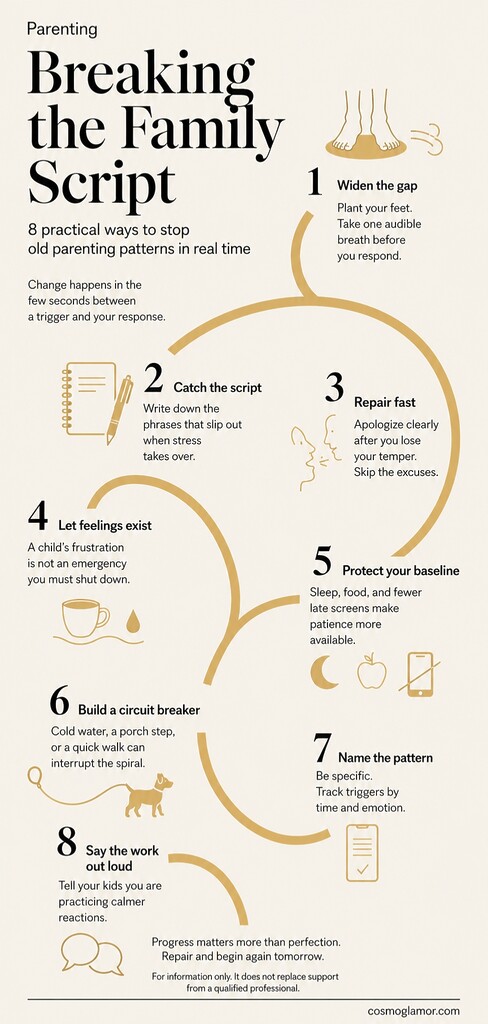
7. Identify the exact patterns you are leaving behind
Telling yourself you just want to be a better mom is too vague to act on. You need to know exactly what you are fighting. Are you stopping the silent treatment? Are you ending the habit of mocking a child's fears? Be ruthlessly specific about the behaviors you are leaving in the past. If you grew up with parenting after childhood trauma, working with a professional is the gold standard for mapping blind spots. You can start the work at home today by tracking your triggers in your phone by time and emotion. Recognizing that your frustration consistently spikes at 5 PM when you feel ignored gives you a logistical target, rather than just an emotional failure.
8. Share the journey appropriately
As your kids get older, you can talk to them about what you are trying to do. You do not need to overshare your own history, but you can absolutely admit that you are practicing how to handle your frustration better. Tell them you are working on taking deep breaths instead of reacting. Narrating your own emotional regulation normalizes the act of self-improvement and models the exact skills you want them to develop as they grow up.
The pressure to get this right every single day is heavy. You are going to have afternoons where you completely revert to the old ways and feel like you have ruined everything. When that happens, forgive yourself, make the apology, and start fresh the next morning. You are entirely capable of writing a new ending for your family.