

I used to think an elegant updo required three hands and a can of industrial hairspray. It turns out, achieving easy French twist hairstyles is mostly about tension and knowing exactly where to hide the pins. Whether you are running late for the school drop-off or just trying to get your hair out of the way before taking Barnaby for a morning walk, this is the style that works for you. It looks incredibly polished, but once you learn the mechanics, it takes less than a minute to pull together.

Jump to the step-by-step length tutorials
The Architecture of a Lasting Twist
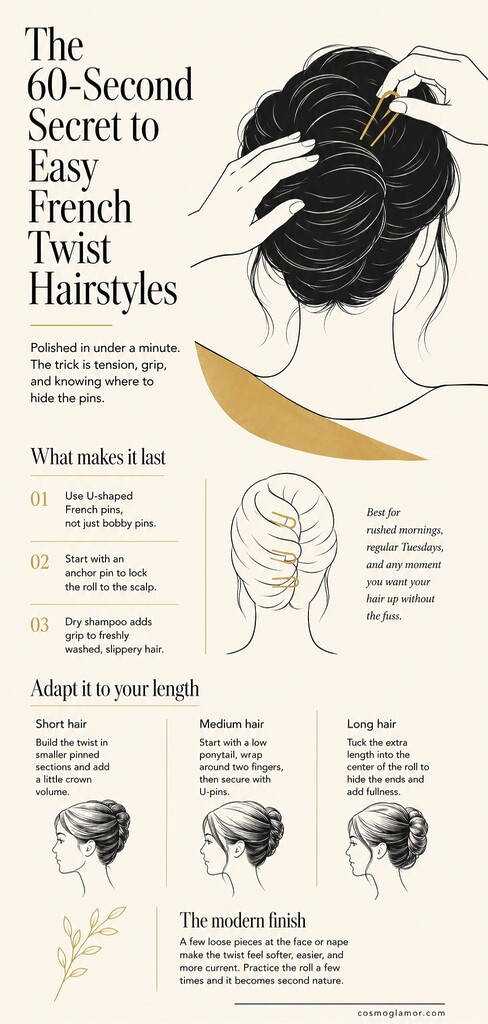
Before you start wrangling your hair, we need to talk about hardware. Standard bobby pins are fine for flyaways, but they struggle to hold the dense core of a rolled twist. Swap them for U-shaped French pins. The wider prongs anchor into the rolled hair and grab the flat hair against your scalp at the same time, distributing the weight evenly so you do not end up with a tension headache by noon.
If you are wondering how to do a French twist that doesn't immediately unravel when you let go, the trick is the anchor pin. Actually, it is the anchor pin combined with the texture of your hair. Freshly washed hair is notoriously slippery. Hit your roots and mid-lengths with a little dry shampoo first to create the grip the pins need to stay put.
Adapting the Twist to Your Length
The biggest mistake we make is trying to force a generic tutorial onto our specific haircut. A shoulder-grazing bob requires a completely different anchoring strategy than waist-length layers. Here is how to make the structure work for the hair you actually have.
1. French Twist for Short Hair
If you have a bob or shoulder-grazing cut, you probably think a twist is out of the question because the bottom layers always fall out. Kayley Melissa's approach completely solves this. Instead of trying to sweep everything up at once, she starts by bumping the crown for volume and then strategically pins smaller sections to build the shape. It takes a little more pinning, but working in sections keeps those short bottom layers from dropping out halfway through your day.
2. French Twist for Medium Hair
Medium hair is often the easiest to twist, but it can still slip if you don't anchor it right. Alex Gaboury has a two-finger wrapping technique that completely changed how I handle my own hair. By starting with a low ponytail and using your fingers as a physical guide to roll the hair, you get a secure, voluminous shape in about sixty seconds. She uses U-shaped pins here, which slide in easily and lock the roll flat against the scalp without pinching.
3. French Twist for Long Hair
The challenge with long hair isn't getting it to twist; it's figuring out what to do with the extra foot of hair sticking out of the top. Left loose, that extra length gets heavy and pulls the twist down. Meli G's method shows you exactly how to tuck those long ends down into the center of the roll before you pin it. Folding the ends into the core acts like stuffing, giving the twist a fuller shape while hiding the excess length entirely.
The Perfectly Imperfect Finish
The slicked-back, incredibly stiff prom twists of the late nineties are behind us. A few loose pieces falling around your face or at the nape of your neck are not mistakes. They are exactly what makes the style look modern and wearable for a regular Tuesday. Grab a handful of pins and practice the roll a few times before you actually need to be somewhere. Once your hands memorize the twisting motion, you will rarely rely on a messy bun again.