

Ever notice how a stressful email instantly hits your stomach? That isn't just nerves; it's biology. Your brain and your digestive tract are in constant communication. When one panics, the other shuts down. If you want to improve your digestion, you have to convince your body it is safe enough to process your lunch. Here is a simple, effective meditation for gut health that flips the switch.

Jump to the 10-minute meditation
Why Your Stomach Needs You to Breathe
I like to think of this practice as a manual override for a stressed nervous system. When you are rushing through your day, your body shifts into a sympathetic state. Your heart rate climbs, your muscles tense, and blood flow is actively diverted away from your digestive organs.
Research suggests that the vagus nerve is the primary information highway between your brain and your gut. You cannot consciously command your stomach to release digestive enzymes or stop cramping. You can, however, control your breathing.
Deep, rhythmic breathing stimulates the vagus nerve. This tells your brain the immediate threat has passed, allowing your body to switch back into a parasympathetic “rest and digest” mode. You do not need to empty your mind or achieve enlightenment to make this work. You just need to change your respiratory rate for a few minutes.
You cannot digest your food while your body thinks it is fighting a bear. Meditation simply tells your nervous system to stand down.
The 10-Minute Gut Reset Meditation
You do not need a perfectly quiet room or a floor cushion to do this. Half the time, I do this sitting in my parked car, or on the living room sofa with Barnaby, our Golden Retriever, resting his heavy head on my foot. Comfort is the only requirement. Set a single, gentle 10-minute alarm on your phone so you don't have to keep checking the time, and just roughly estimate the intervals below as you go.

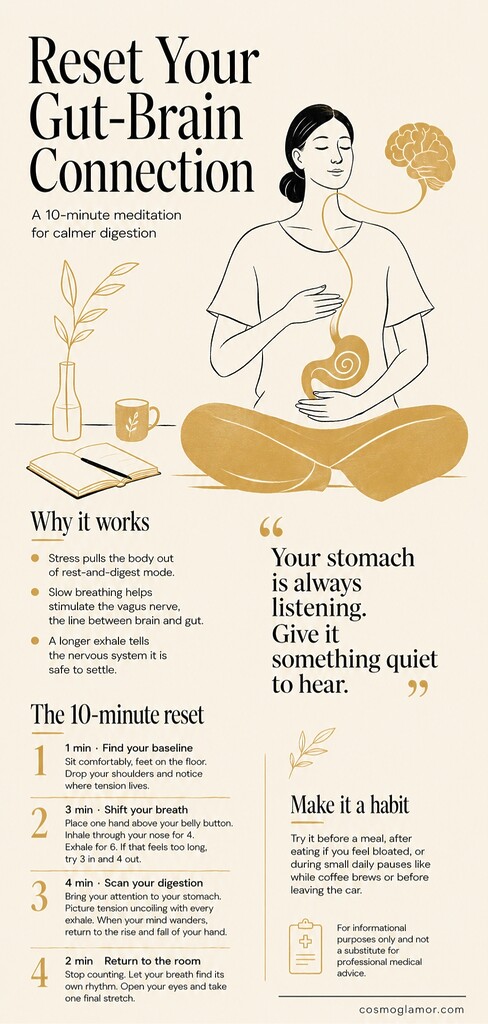
- Find your physical baseline (roughly 1 minute). Sit comfortably with your feet flat on the floor. Let your shoulders drop away from your ears. Close your eyes and notice where your body feels tight. Do not try to fix the tension yet; just map out where it lives.
- Shift your breathing pattern (roughly 3 minutes). Place one hand just above your belly button. Inhale slowly through your nose for a count of four, feeling your hand rise. Breathing into your palm encourages the diaphragm to expand, which supports slower breathing and helps your nervous system settle. Exhale through your mouth for a count of six. The extended exhale is the biological trigger for relaxation. If counting to six makes you feel lightheaded, shorten the ratio to three counts in and four counts out. The goal is simply making the exhale longer than the inhale.
- Do a targeted digestion scan (roughly 4 minutes). Bring your full attention to your stomach. Visualize the tension in your abdomen uncoiling like a tight spring with every exhale. If you feel gurgling or movement, that is a positive sign your digestive tract is waking back up. If your mind wanders to your grocery list or your inbox, acknowledge the thought, let it go, and bring your focus right back to the rise and fall of the hand on your stomach.
- Return to the room (roughly 2 minutes). Stop counting your breaths and let your lungs find their natural rhythm. When your alarm chimes, wiggle your toes, open your eyes, and take one final, deep stretch before standing up.
Making Mindfulness for Gut Health a Habit
A single 10-minute session may help a stressy stomach feel calmer right now, but consistency is where practices like mindfulness seem to show the most promise for digestion-related symptoms. It is less about forcing your gut to behave and more about giving your nervous system a familiar route back to calm.
If finding ten uninterrupted minutes feels impossible, anchor the habit to something you already do every day. Try running through the breathing sequence while your morning coffee brews or sitting in your car for a few minutes before walking into the grocery store. I treat this stress relief meditation for digestion just like taking a daily vitamin. It is a non-negotiable part of keeping my system running smoothly.
Common Questions About Meditation and Digestion
Should I meditate before or after a meal?
Doing this right before you eat can be helpful, especially if stress is part of your stomach pattern. Taking just three to five minutes to do the breathing sequence before a meal gives your nervous system a chance to settle before food arrives. If you often feel bloated immediately after eating, doing this post-meal can also help you slow down and relax while your body gets to work.
Does it matter if I sit up or lie down?
Position does not matter as much as lung capacity. Lying flat on your back often makes it easier to breathe deeply into your belly without your posture getting in the way. If you have acid reflux, however, sitting upright is generally the safer choice.
Your stomach is always listening. Give it something quiet to hear.
Sources
- Adrenaline: Where the hormone is located and what it does — Cleveland Clinic, 2022.
- Effects of voluntary slow breathing on heart rate and heart rate variability — Neuroscience & Biobehavioral Reviews, 2022.
- Meditation and irritable bowel syndrome — Journal of Clinical Medicine, 2022.
- GERD diagnosis and treatment — Mayo Clinic, 2025.
- Gut-brain crosstalk: the vagus nerve and the microbiota-gut-brain axis — Journal of Affective Disorders Reports, 2023.