





We tend to blame a lot of daily discomforts on getting older, a stressful week, or just a bad night of sleep. But if you are constantly waking up exhausted, bloated after every meal, or fighting off sugar cravings that feel like an emergency, the problem may not be your willpower or your age. Your microbiome can be part of the picture.

The Body's Digestive Red Flags
Your gut houses trillions of bacteria that influence everything from how you digest a salad to the signaling pathways tied to mood, appetite, and sleep. When the balance shifts away from a diverse, resilient mix, a state clinical researchers call dysbiosis, your body starts sending up flares. You don't need a restrictive juice cleanse to fix it. You just need to know what you are looking for.
1. You are bloated after almost everything you eat
Occasional fullness after a massive holiday dinner is normal. Actually, let me clarify that. A little temporary fullness makes sense, but ballooning up and feeling painful pressure after eating a seemingly healthy lunch does not. When digestion is sluggish or certain carbohydrates are not fully absorbed, bacteria can ferment those leftovers, producing gas that stretches your intestines and causes that tight feeling.
2. Your sugar cravings feel like an emergency
If you finish a meal and feel an intense, undeniable pull toward the pantry for something sweet, your gut bugs might literally be asking for it. Certain microbes thrive on simple carbohydrates. When your microbiome shifts, researchers think those microbes may influence reward and satiety, mood, taste receptors, and vagus-nerve signaling in ways that can nudge appetite, though cravings are never caused by gut bacteria alone.
3. You are waking up exhausted
You slept for eight hours, but you feel like you barely closed your eyes. Your gut is involved in serotonin signaling, and gut microbes appear to interact with several pathways tied to sleep, including tryptophan, melatonin, and immune signaling. A struggling gut may be one piece of disrupted sleep, leaving you stuck in lighter sleep and waking up drained.

4. Your skin is acting up out of nowhere
Acne, eczema, and unexplained rashes can sometimes overlap with changes in the digestive tract. Research on the gut-skin axis suggests that when the gut barrier and microbiome are disrupted, immune signaling can shift in ways that add to systemic inflammation, and that can show up on your face or arms.
5. You have “brain fog” that coffee won't touch
If you find yourself losing your train of thought or struggling to focus on basic tasks by 2:00 PM, your digestion is likely involved. Gut inflammation can drive immune signals, including cytokines, that communicate with the brain. You can't caffeine your way out of brain fog when the root issue is inflammatory signaling.
6. Your mood swings are becoming unpredictable
The gut-brain connection is a physical, biological superhighway. Because gut microbes help shape immune, endocrine, and neural signaling, a sudden shift toward anxiety, irritability, or low mood can sometimes overlap with poor gut health.
7. Your bathroom habits are entirely erratic
Healthy digestion is boring and predictable. If you are constantly swinging between constipation and urgency, or if your schedule changes completely from day to day without a shift in your diet, your gut motility is compromised. A healthy microbiome produces short-chain fatty acids that help support the muscular contractions of your intestines, keeping things closer to a steady, rhythmic pace.
8. You are catching every cold that goes around
Roughly 70 to 80 percent of your immune cells are present in the gut. If you feel like you are always nursing a mild sore throat, the sniffles, or a lingering cough, your internal defense system may be under-resourced and struggling to keep up with daily viral exposure.

9. Your weight won't budge, despite your efforts
Years ago, when I was actively trying to lower my A1C and manage my metabolic health, I hit a frustrating wall. I was eating cleanly, but the scale and my blood sugar wouldn't move. What I learned from the clinical data changed everything: certain obesity-associated microbiome patterns may have an increased capacity to harvest energy from food. Furthermore, gut microbial carbohydrate metabolism and inflammation have been linked with insulin resistance, making stored energy harder to access.
How to Actually “Detox” Your Gut
The word detox has been hijacked by marketers selling expensive laxative teas and three-day liquid fasts. Your body doesn't need a violent flush. Your liver, kidneys, and gut are built to handle detoxification every day, provided you stop handing them materials they have to fight.
A real gut detox isn't about drinking cayenne pepper water for three days; it is about giving your microbiome the exact building blocks it needs to repair itself.
To reset your system, focus purely on removal and replacement. Briefly reduce the refined sugars, artificial sweeteners, and highly processed oils that can work against a healthier mix of gut bacteria. Replace them with prebiotic fibers (like garlic, onions, leeks, and asparagus) to feed the good bacteria, and introduce live-culture fermented foods (like sauerkraut, kimchi, or plain milk kefir) to support microbial diversity.
Just a quick reminder: I am a researcher and recipe developer, not a doctor. If your digestive symptoms are severe, painful, or sudden, always check in with your primary care physician to rule out anything serious before changing your routine.
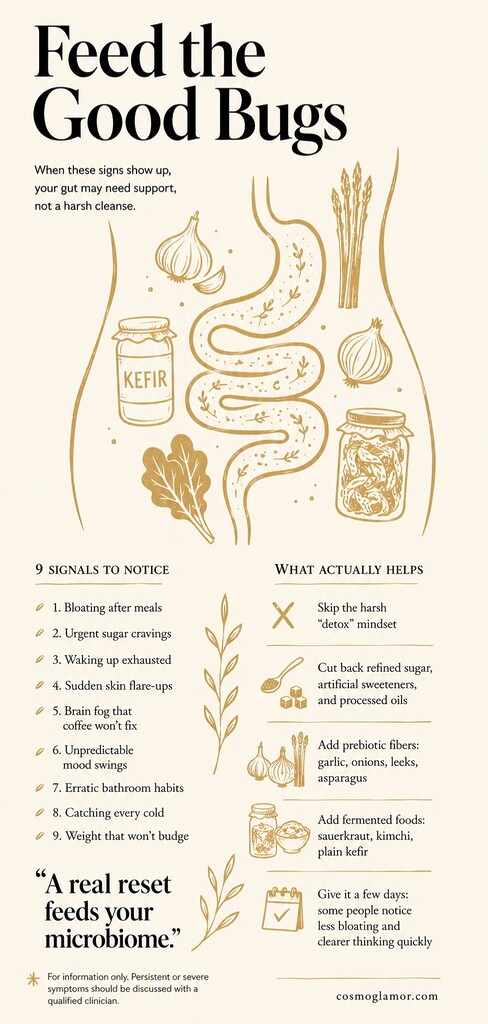
Common Questions About Resetting Your Gut
Will I feel worse before I feel better?
You might. If you abruptly cut out daily sugar and refined carbohydrates, it is entirely common to experience a mild headache, fatigue, or moodiness around day two or three. This is likely a normal adjustment to a sudden diet change, not a sign that eating whole foods is bad for you. Drink plenty of water and keep the changes steady; for many people, the rough patch eases within a few days.
How long does it take to see real results?
The microbiome is highly responsive. While deeper healing of the gut lining can take months, some people notice changes in bloating and mental clarity within days of changing their dietary inputs. Your bacteria can respond within days to what you feed them.
Your body is incredibly resilient when you stop asking it to work against itself. Give your digestion the raw materials it is asking for, and it will get right back to working for you.
Sources
- Eating behavior and gut microbiota – BioEssays, 2014.
- Gut microbiome and sleep quality – Nutrients, 2024.
- Gut microbiota and inflammatory skin disease – The Microbe, 2025.
- Gut microbiome and immune system – Nutrients, 2021.
- Gut microbiome, inflammation, and insulin resistance – Signal Transduction and Targeted Therapy, 2024.
- Gut-microbiota-targeted diets – Cell, 2021.
- Diet rapidly alters the gut microbiome – Nature, 2014.
- Gas in the digestive tract – NIDDK, 2021.
- Gut microbiota-immune-brain axis – Cell Reports Medicine, 2025.
- Obesity-associated microbiome and energy harvest – Nature, 2006.