



The promise of dropping up to ten pounds in a single week is a heavy hook. The 3 day military diet relies on a rigid, highly specific menu for three days, followed by four days of normal eating. It requires no subscriptions, no special shakes, and no exotic ingredients, which explains why it continually resurfaces in wellness circles right before wedding season.

Before you stock up on canned tuna and cottage cheese, it helps to understand the mechanics of what a 3 day diet plan actually does to your metabolism. The results you see on the scale on Thursday morning are real numbers, but they do not mean what you probably hope they mean.
The Military Diet Meal Plan: Days 1 to 3
This routine is essentially a strict form of intermittent calorie restriction. You consume roughly 1,100 to 1,400 calories per day for the first three days. The menu combinations are very specific, and proponents claim the chemical interactions of these specific foods accelerate metabolism. Research has not substantiated those specific chemical claims, but the severe calorie deficit will certainly cause a rapid shift in your body mass.
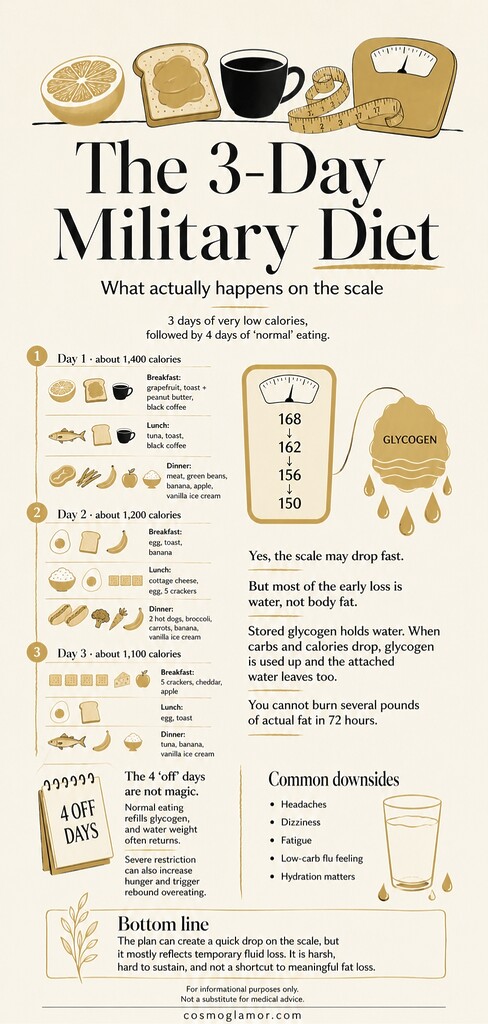
Day 1 (Roughly 1,400 Calories)
Breakfast consists of half a grapefruit, one slice of toast with two tablespoons of peanut butter, and one cup of caffeinated coffee or tea. You cannot add sugar or cream to the coffee.
Lunch is remarkably sparse. You eat half a cup of tuna, one slice of toast, and another cup of black coffee or tea.
Dinner offers a slightly larger volume. You are allowed three ounces of any type of meat, one cup of green beans, half a banana, one small apple, and one cup of vanilla ice cream.
Day 2 (Roughly 1,200 Calories)
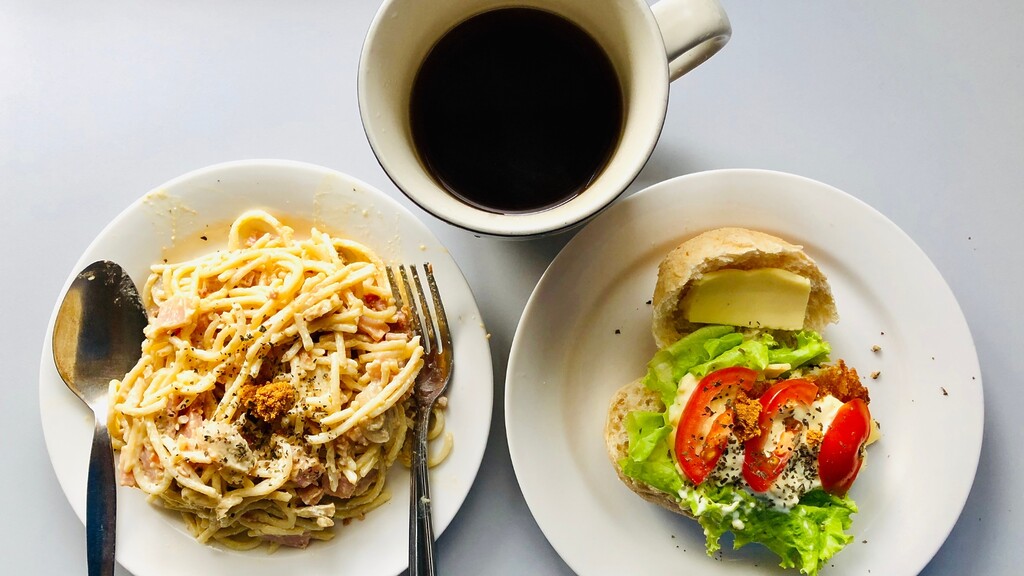
Breakfast is one egg cooked however you prefer, one slice of toast, and half a banana.
Lunch drops the calories further with one cup of cottage cheese, one hard-boiled egg, and five saltine crackers.
Dinner is highly specific. You eat two hot dogs without the buns, one cup of broccoli, half a cup of carrots, half a banana, and half a cup of vanilla ice cream.
Day 3 (Roughly 1,100 Calories)
Breakfast shrinks to five saltine crackers, one slice of cheddar cheese, and a small apple.
Lunch is simply one egg cooked to your preference and one slice of toast.
Dinner consists of one cup of tuna, half a banana, and one cup of vanilla ice cream.
Analyzing the Military Diet Results
If you follow the plan perfectly, the scale will almost certainly move. Many people do wake up on the fourth day several pounds lighter. Understanding why that happens is the key to deciding if this protocol is actually worth your time.
When I was tracking my own daily health metrics to safely drop 50 pounds, I closely monitored how my body reacted to sudden shifts in carbohydrates and overall food volume. Your body stores backup energy in your liver and muscles in the form of glycogen. Every gram of glycogen is bound to roughly three grams of water.
When you abruptly cut your calories and carbohydrates down to the levels seen in this plan, your body burns through those stored glycogen reserves to keep you functioning. As the glycogen gets used up, all the attached water is flushed out through your kidneys.
The military diet results you see on the scale are largely the mathematical result of this fluid loss. You are not losing five pounds of adipose fat tissue in 72 hours. A pound of fat stores about 3,500 calories of energy. You simply cannot create a deficit large enough in three days to burn several pounds of actual fat mass, no matter how much black coffee you drink.
The Physiology of the “Four Days Off”
The diet outlines four subsequent days of normal eating, recommending you keep your intake below 1,500 calories. This is where the biological bill comes due.
Three days of severe restriction can make hunger feel louder, and longer bouts of calorie restriction can raise ghrelin, the hormone that signals hunger to your brain. By Thursday morning, your body is actively pushing you to replenish the energy stores you just emptied. If you are not incredibly disciplined, those four “off” days often turn into a rebound binge.
Even if you manage to eat perfectly moderate meals on your days off, the scale will likely creep back up. As soon as you eat normal portions of carbohydrates, your body restores its glycogen reserves, and the associated water weight returns. This is not a failure of willpower. It is basic human physiology repairing itself.
Safety and Practical Reality
Aggressive calorie restriction can cause blood sugar to drop rapidly, which often leads to headaches, dizziness, and intense fatigue. Always consult your physician before starting any extreme calorie deficit program, especially if you have an underlying metabolic condition or a history of disordered eating.
If you do decide to test a short period of restriction, keep a glass of water nearby. When carbohydrate intake drops, lower insulin can increase sodium and water losses, which may contribute to that heavy, brain-fogged feeling commonly called the “low-carb flu.” Hydration matters here, but extra salt is not a safe default if you have high blood pressure, kidney disease, or take medications that affect fluid balance.
I know the temptation of a quick fix. I remember looking at a calendar, doing the mental math on an upcoming event, and desperately wanting a shortcut. The problem is that shortcuts like this require an immense amount of mental energy to endure, and the physical results rarely last past the weekend.
Common Friction Points
You might be thinking about a friend who swears by this exact protocol and kept the weight off. It happens. But when it does, it is usually because the grueling three days forced them to confront their overall portion sizes, leading them to eat more mindfully during the other four days of the week.
The vanilla ice cream and hot dogs are not magic fat-burning compounds. They are just cheap, easily measurable foods that fit into a rigid mathematical box. If you swap the hot dogs for a plain chicken breast of the same caloric value, your body will process the deficit exactly the same way.
The Bottom Line
A diet plan should make your life easier to manage, not harder. This protocol treats your body like a spreadsheet, forcing it into a severe deficit that creates the illusion of rapid fat loss. You do not need a punishing three-day bootcamp to change your body composition. You just need a practical, protein-rich routine that you do not hate waking up to on a normal Tuesday.
Sources
- Muscle Water and Glycogen Recovery — European Journal of Applied Physiology, 2015.
- Energy Content of Weight Loss — Metabolism, 2012.
- Fasting Appetite-Related Gut Hormone Responses — International Journal of Obesity, 2025.
- Low Blood Glucose — NIDDK, 2026.
- Insulin and Renal Sodium Metabolism — Diabetologia, 1981.
- Effects of Sodium and Potassium — CDC, 2025.
- Chronic Kidney Disease Treatment — Mayo Clinic, 2025.
- Diuretics — Mayo Clinic, 2025.
- Very Low-Calorie Diets — National Institutes of Health, 1993.
- Save for Later1.2K




14 Responses
I was skeptical at first, but the 3-Day Military Diet really surprised me! It’s amazing how much difference just three days can make. The meal plan is super easy to follow and the food is surprisingly good. I lost a few pounds and felt more energized by the end of it. If you’re looking for a quick and effective way to kickstart your weight loss, I highly recommend giving this a try!
Thank you for sharing your experience! We’re delighted to hear that the 3-Day Military Diet worked well for you and that you saw positive results. Our goal is to provide effective and easy-to-follow plans that deliver real results, so it’s great to know you found the meals enjoyable and energizing. Keep up the great work, and if you have any questions or need further assistance, feel free to reach out. We’re here to support you!
I’m really tempted to try this diet because I need to lose weight fast for my cousin’s wedding next month. But is it really safe to lose 10 pounds in a week? That sounds a bit extreme to me.
Hi Michelle, I understand the desire for quick results, especially with a big event coming up! While the Military Diet might result in rapid initial weight loss, it’s important to be cautious. Losing 10 pounds in a week is quite drastic, and much of that might be water weight. It’s generally recommended to aim for a more sustainable weight loss rate of 1-2 pounds per week. Also, such extreme restrictions can be hard on your body. I’d recommend focusing on making healthier choices overall, rather than relying on a crash diet. If you’re set on trying the Military Diet, please talk to your doctor first to make sure it’s safe for you, and consider it a very short-term solution, not a long-term plan.
This diet seems really restrictive. I’m worried about feeling hungry and tired all the time. Are there any snacks allowed on the Military Diet, or do you just have to suffer through the three days?
Hi Amanda, you’re right, the Military Diet is quite restrictive, and hunger can definitely be a challenge. Snacking isn’t typically allowed during the first three days, which is why it’s so important to drink plenty of water to help you feel full. Some variations of the diet might allow for a small, low-calorie snack, but it’s not part of the standard plan. If you’re concerned about managing hunger, this might not be the best diet for you. A more sustainable approach would involve incorporating healthy snacks between meals to keep your energy levels up and prevent extreme hunger.
This article is super informative! The Military Diet sounds pretty straightforward, but I’m a little worried about the lack of fruits and veggies. Don’t those play a big role in healthy weight loss? Also, three ounces of meat seems a bit small for someone who exercises regularly, like me. Will I be left feeling super hungry on this diet
Hi Sarah, thanks for your comment! You’re absolutely right, fruits and veggies are crucial for healthy weight loss. They provide essential vitamins, minerals, and fiber, which keep you feeling full and energized. The Military Diet’s limited variety might not offer the best balance in that regard.
As for portion sizes, it’s true that three ounces of meat might leave someone who exercises regularly feeling a little hungry. You could discuss adjusting the protein portions slightly with a healthcare professional or registered dietitian to ensure you’re getting enough nutrients to support your activity level.
Remember, the Military Diet is a short-term plan. It might be a good idea to follow it for the initial three days, then transition to a more balanced, sustainable approach that incorporates plenty of fruits, veggies, and whole grains alongside lean proteins. This way, you can lose weight in a healthy way and keep it off in the long run!
Okay, so ice cream is involved? You had me at ice cream! But seriously, this diet seems…odd. Hot dogs and ice cream? It feels like a pregnancy craving, not a weight loss plan! 😂 I’m also wondering, does this diet actually work, or is it just water weight I’ll lose and then gain back as soon as I look at a slice of pizza? Because I love pizza.
Hi Jessica, thanks for your comment! I know, the hot dogs and ice cream combo is a bit of a head-scratcher! It definitely doesn’t scream “health food,” does it? 😂 And you’re right to be skeptical about the weight loss. A significant portion of the initial weight loss on the Military Diet is likely due to water weight from the calorie restriction and carbohydrate reduction. So, yes, there’s a good chance you’ll regain some of that when you resume your regular eating habits (especially if “regular” involves pizza – which, let’s be honest, is amazing!).
The Military Diet can offer a quick jumpstart, but it’s not a sustainable long-term solution. It’s best to view it as a very short-term fix, not a permanent lifestyle change. If you’re looking for lasting weight loss, a balanced diet and regular exercise are still the best way to go. You can still enjoy pizza occasionally, just maybe not the whole pie in one sitting! 😉
Okay, I’m a little confused. This article says the Military Diet is super restrictive, but then it lists vanilla ice cream as a dessert?! That seems a little counterintuitive to me. How can you eat ice cream and still lose 10 pounds in a week? Is this diet just setting people up for failure by including “treats” that are going to make them crave more sugary foods? Also, does anyone know if there’s a vegetarian version of this? I’m skeptical…
Hey Melissa, you’ve hit on a common point of confusion with the Military Diet! The ice cream does seem a bit odd, right? The thinking is that a small, controlled portion of a “treat” might help people stick to the diet better, preventing them from feeling totally deprived and binging later. It’s also about creating a calorie deficit – even with the ice cream, the total calorie count for those days is still very low.
However, you’re right to question whether this sets people up for long-term success. Cravings are a real issue, and a little ice cream might not be enough to satisfy everyone. As for a vegetarian version, the main protein sources can be substituted. You could use tofu, lentils, or meat substitutes in place of the meat and fish. That said, you’d want to be very careful to ensure you are getting enough protein and the right balance of nutrients.
There are also vegetarian protein sources that can be used in place of cottage cheese, such as; silken tofu, Greek yogurt, or ricotta cheese. Instead of eggs you could have, Chia seed pudding, or a tofu scramble.
It’s always best to consult with a doctor or a nutritionist before starting a very restrictive diet like this, especially if you have specific dietary needs. They can help you make informed choices!
I tried this diet a few years ago before my sister’s wedding. I did lose some weight, but I felt absolutely terrible the whole time! I was tired, cranky, and constantly hungry. As soon as I went back to eating normally, the weight came right back. It felt like a total waste of time, and honestly, I think it messed up my relationship with food for a while. Has anyone else had this experience? I’m all for finding a sustainable way to lose weight, but this quick-fix stuff just doesn’t seem worth it. Is there any real evidence that this even works in the long run?
Sophia, thanks for sharing your experience. It’s a story that many can relate to, unfortunately. You’re absolutely right that the side effects of very low-calorie diets can be rough. Fatigue, irritability, and hunger are common complaints, and they make it really hard to stick to the plan, let alone feel good!
You’ve also nailed the biggest issue with the Military Diet: it’s just not sustainable. The weight that comes back on is often water weight and can be discouraging. The long-term effectiveness is also questionable as you have pointed out. There are some studies that suggest short-term calorie restriction can lead to weight loss, but they often don’t address the issue of weight maintenance afterward. There are links to scientific studies at the end of my article for you to look at if you wish.
The focus should really be on making gradual, sustainable lifestyle changes rather than resorting to crash diets. This includes eating a balanced diet of whole foods, exercising regularly, and getting enough sleep. It might take longer to see results, but it’s a much healthier and more effective approach in the long run. If anyone is seriously considering the Military Diet, please talk to a doctor or dietitian first. It’s essential to make sure it’s a safe and appropriate choice for you.