

We all hit that wall where every meal feels heavy and digestion slows to a crawl. When I need to break a plateau, I do not starve myself. Instead, I use a nutrient-dense protocol to clear the slate and give my system a break.

Moving Past the 90s Fad
Most of us remember the classic 7 day cabbage soup diet from decades ago. People treated it as a crash course in deprivation. I approach it differently today. When I lost 50 pounds, I learned that forced starvation always backfires. A strategic, temporary shift in meal volume, however, can help you reset your routine.
This plan is not about living on zero calories. It is about front-loading your week with soft-cooked vegetables and deep hydration so your meals feel lighter and your digestion has less to work through. You are using this cabbage soup reset as a specific tool to simplify the week, not as a permanent way to live.
The Mechanics: Why a Cabbage Soup Diet for Bloating Works
Bloat can come from sluggish digestion, excess sodium retention, or certain foods triggering gas. Cabbage brings vegetable fiber, but it can also bother sensitive stomachs if you overdo it. Boiling the cabbage softens the texture beforehand, making it gentler than a giant raw salad for many people while still giving the meal real volume.
Using a cabbage soup diet for bloating may help because you are replacing heavy, processed meals with a high-water, vegetable-rich base. Potassium helps your body balance sodium and fluid volume, which can ease water retention for some people. You are giving your body a lighter, more hydrated setup.
A reset shouldn't feel like a punishment. It is a strategic resting period for an overworked digestive system.
Who Should Skip This Reset
Because this protocol intentionally drops your carbohydrate intake and total calories for a few days, it is not a universal fix. Always consult your physician before starting any new diet or metabolic reset, especially if you take prescription medications. Pregnant or nursing women, individuals with a history of disordered eating, people with kidney disease, and anyone managing conditions that require a steady, predictable carbohydrate intake should skip this entirely. A reset is only healthy if your body is in a position to handle the shift.
Your Actionable Grocery List
To make it through the full seven days without running to the store every night, buy these staples upfront:
- 2 medium heads of green cabbage
- 2 large yellow onions and 1 head of garlic
- 1 bunch of celery and 1 bag of carrots
- 4 cartons (32 ounces each) of low-sodium chicken or vegetable broth
- 3 cans (14.5 ounces) of diced tomatoes
- 4 pounds of lean protein (chicken breast, ground turkey, or white fish)
- Eggs and a few complex carbohydrates (like sweet potatoes or quinoa) for the transition days
The Core Recipe & Storage
Before you start the week, you need a large batch of the base soup. This recipe makes roughly eight servings. Place a large pot over medium heat and sauté the chopped onions, 2 sliced carrots, and 3 diced celery stalks in a drop of olive oil for about five minutes until soft. Stir in 2 minced garlic cloves for one more minute. Pour in 6 cups of broth, one can of tomatoes, and one chopped cabbage. Bring the pot to a boil, then lower the heat and let it simmer for 25 minutes until the cabbage is completely tender.
Store the soup in glass containers rather than plastic so the material does not absorb the strong, lingering sulfur odor of the cabbage. It holds up safely in the fridge for up to four days. Freeze the second half of the batch immediately to keep the vegetables from turning to mush by day six.
Eating the exact same flavor profile for seven days causes palate fatigue. You can change the soup's profile daily without adding calories by dropping in a pinch of red pepper flakes and grated ginger for heat, or fresh dill and a squeeze of lemon for a brighter, Greek-inspired finish.
The 7-Day Protocol
Instead of eating nothing but soup, you use the soup as your anchor. You eat it before your main meals to fill up on nutrient-dense volume, or you use it as a complete meal replacement for dinner to keep evening digestion light.
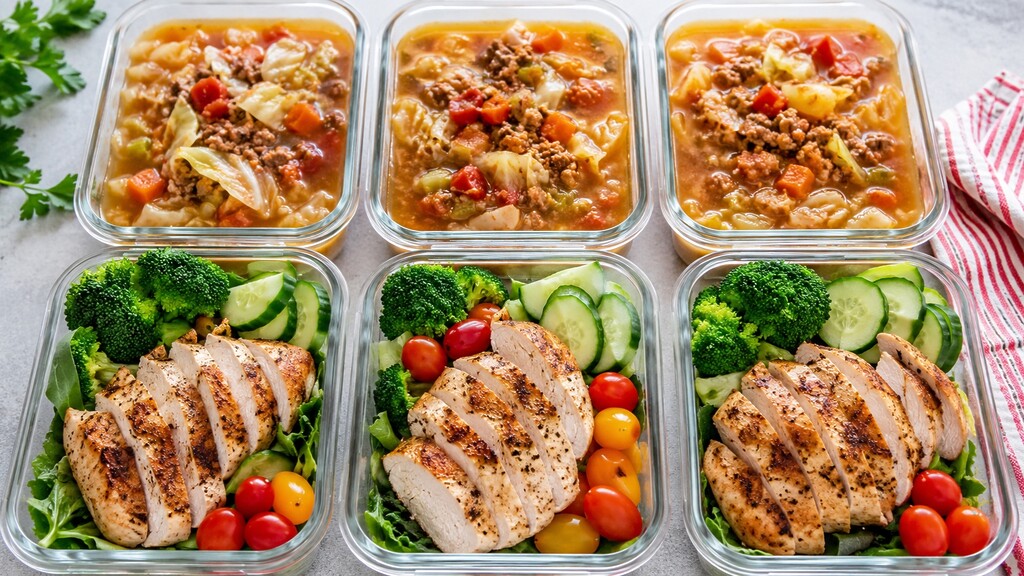
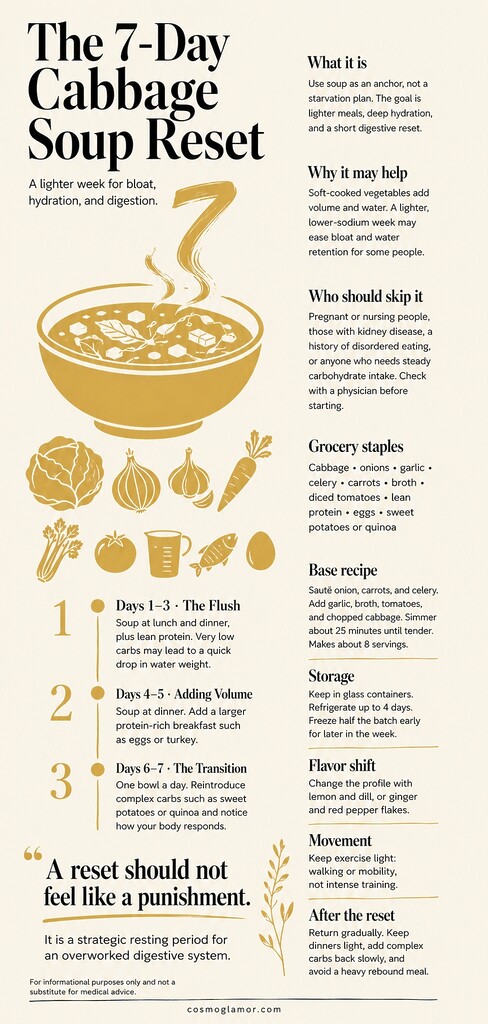
Days 1 to 3: The Flush. Eat the soup for lunch and dinner, paired with a lean protein like grilled chicken or baked cod. Keeping carbohydrates very low these first few days can make your body draw more heavily on stored glycogen, and because glycogen is stored with water, that can drop the initial water weight quickly.
Days 4 to 5: Adding Volume. Keep the soup for dinner, but introduce a larger protein-heavy breakfast. Scrambled eggs or ground turkey work well here to keep your energy stable as your body adjusts to the lighter dinners.
Days 6 to 7: The Transition. Reduce the soup to one bowl a day. Reintroduce complex carbohydrates like roasted sweet potatoes or quinoa to see how your body responds without the bloat. This can help you notice food and symptom patterns that might have been causing the sluggishness in the first place.
Common Questions About the Reset
Should I work out during this week?
Keep your movement light. Heavy lifting or high-intensity intervals require more glycogen than this plan provides. Stick to walking or basic mobility routines that keep your joints loose without exhausting your muscles.
How much soup is too much?
There is no strict limit. Listen to your body's cues. If you feel comfortably full, stop eating. The goal is nourishment, not forcing down endless bowls just because it is allowed.
Transitioning Out Without the Rebound
The biggest mistake people make is finishing a reset and immediately ordering a pizza. Your digestive tract has just spent a week working with clean, simple inputs. Hitting it with heavy dairy and refined sugar may bring the bloat right back.
The goal is to move from this short-term intervention into a sustainable routine. You want to carry the momentum forward by keeping your dinners relatively light and your protein intake high.
A week of simple, vegetable-heavy meals will not magically solve every health hurdle you face. But taking seven days to quiet the noise, hydrate deeply, and give your digestion a clean slate might be exactly what you need to start hearing your body's signals again.
Sources
- Eating, Diet, & Nutrition for Gas in the Digestive Tract – National Institute of Diabetes and Digestive and Kidney Diseases, 2021.
- Kidney Is Essential for Blood Pressure Modulation by Dietary Potassium – Current Cardiology Reports, 2020.
- Low-carbohydrate diets for people with type 1 and type 2 diabetes – Dietitians Australia, 2026.
- Don’t Flunk Food Safety This School Year – U.S. Department of Agriculture, 2023.
- Muscle Glycogen Assessment and Relationship with Body Hydration Status – Nutrients, 2023.
- Save for Later154.9K


24 Responses
I decided to give the Cabbage Soup Diet a try, and I’m so glad I did! In just a week, I lost a noticeable amount of weight and felt lighter and more energetic. The soup is surprisingly tasty and kept me full throughout the day. It’s a great way to kickstart your weight loss journey or shed a few pounds quickly. Highly recommend it to anyone looking for a simple and effective diet plan!
“Thank you for sharing your success with the Cabbage Soup Diet! We’re thrilled to hear that it worked well for you and that you enjoyed the soup. Our aim is to provide simple and effective diet plans that help people achieve their weight loss goals. Keep up the fantastic progress, and if you have any questions or need further assistance, feel free to reach out. We’re here to support you on your journey!
Any idea on how many calories per bowl this soup is?
Great question! Each bowl of the wonder soup is roughly 60-70 calories. This can vary slightly based on portion size and any extra ingredients you add, like a teaspoon of olive oil. It’s designed to be low-calorie to help keep you full and support your weight loss goals. Feel free to adjust the recipe to fit your needs!
Why/how have all the menus changed? I am on my last day and was checking for sure what to have for dinner. The whole day was different, then looking at the other days, they are all different! There were no eggs or humus in the other plan.
Hi Loretta,
Thank you for your feedback! We recently updated the meal plan to enhance variety and nutrition, which is why you noticed changes like the addition of eggs and hummus. We apologize for any confusion and appreciate your understanding. If you have any questions, feel free to reach out. Best of luck on your last day!
Warm regards
I’ve heard about this diet before, but I’m worried about gaining all the weight back as soon as I stop. Is that a real concern, and how can I prevent it?
Hi Jennifer, that’s a very valid concern and a common one with this diet. You’re right, the initial weight loss is largely water weight. To prevent regaining it, it’s crucial to transition to a balanced, sustainable eating plan after the 7 days. The “Long-Term Effects and Maintaining Weight Loss” section specifically addresses this. Focus on whole, unprocessed foods, portion control, and regular exercise. Think of the Cabbage Soup Diet as a kickstart, not a long-term solution!
I’m a pretty active guy. Can I still work out while on this diet? I don’t want to lose muscle mass.
Hi Michael, that’s a great question. Since the Cabbage Soup Diet is low in calories and protein, intense workouts aren’t recommended. Light to moderate exercise like walking or yoga is okay, but listen to your body. The “Exercise Recommendations” section provides some guidance. To minimize muscle loss, make sure you’re getting enough protein on the protein-focused days, and consider incorporating some light resistance training if your body feels up to it. After the diet, gradually increase your protein intake and resume your regular workouts.
This sounds too good to be true! I’ve tried so many diets, and they always seem to backfire. I’m worried that losing 10 pounds in a week is just water weight and it will all come back as soon as I start eating normally again. Plus, is it really healthy to eat mostly soup for a whole week? I’m a little skeptical…
Hi Brenda, thanks for your comment! You’re right to be cautious about quick-fix diets. I totally understand your skepticism, and I had the same concerns when I first heard about the Cabbage Soup Diet. You’re absolutely correct that a significant portion of the initial weight loss is water weight, especially in the first few days. That’s why I emphasize throughout the article that this is not a long-term solution but rather a short-term strategy.
Regarding the health aspect, the diet does provide a good amount of fiber and vegetables, but it’s definitely not nutritionally complete for long-term sustenance. That’s why I strongly recommend transitioning to a balanced diet on Day 8 (and beyond!). The plan I provided includes a sample meal plan for that transition day to help guide people toward healthier eating habits. It’s really about using this diet as a jumpstart to a more sustainable lifestyle, not a permanent way of eating. I hope that addresses your concerns! Remember, it is a good practice to speak with your doctor before starting any diet.
I’m intrigued by the idea, but I’m also a very active person. I usually work out 5-6 days a week, including some pretty intense cardio. Will I have enough energy to keep up my workouts on this diet? I’m worried about feeling weak or sluggish.
Hi Ashley, that’s a great question! Given your high activity level, it’s important to listen to your body very carefully on this diet. Because the calorie intake is significantly reduced, you might find that your energy levels are lower than usual. I generally advise against strenuous exercise during the 7 days of the Cabbage Soup Diet.
In the article, under the “Exercise Recommendations” section, I suggest sticking to lighter activities like walking, yoga, or swimming. You could also consider modifying the diet slightly to include more protein or complex carbs on your workout days, but I’d recommend consulting with a doctor or registered dietitian to make sure you’re doing so safely. It’s crucial to avoid pushing yourself too hard, especially during a period of calorie restriction. The primary goal is to fuel your body adequately while still achieving a calorie deficit. Your health and well-being should always come first!
Okay, I’ll admit it, I’m intrigued. Desperate times, desperate measures, and all that. My high school reunion is in two weeks, and I’d love to squeeze back into my “glory days” jeans. But cabbage soup for a whole week? Doesn’t that get, well, boring? And let’s be real, will I be spending the entire week in the bathroom? Also, 10 pounds in a week sounds a bit drastic, is that even healthy? I need the truth, not just the “wonder soup” hype!
Molly, I hear you! Reunions can definitely be a motivator! Look, the Cabbage Soup Diet is a short-term solution, not a lifestyle change. Yes, the soup can get repetitive, but I’ve included some tips to spice it up (literally!). Think chili flakes, different herbs, maybe even a dash of hot sauce if you’re feeling adventurous. As for the bathroom situation… let’s just say fiber is your friend, and things will be moving. It’s not as bad as you might think, though. And regarding the 10 pounds, a lot of that is water weight, especially in the first few days. It’s a quick drop, but it’s not necessarily sustainable. This diet is more about jumpstarting your weight loss and giving you a quick win. It’s definitely not for everyone, and it’s super important to listen to your body and check with your doctor first, especially if you have any health concerns.
So, I tried a version of this diet years ago, and it was a disaster. I was cranky, hungry, and basically lived on cabbage fumes. Plus, the soup tasted like dishwater. Has this “wonder soup” actually been taste-tested by real humans? And what happens after the 7 days? Do I just go back to eating pizza and magically keep the weight off? I need some serious convincing here.
Maisie, I totally understand your skepticism. I’ve been there too! Trust me, this isn’t your grandma’s bland cabbage soup. This recipe has some serious flavor upgrades – think diced tomatoes, broth instead of water, and a blend of spices that’ll actually make you want to eat it. Plus, you get to add other foods each day, so it’s not just soup 24/7. As for the after-diet plan, that’s crucial! You can’t just go back to your old habits and expect the weight to stay off. Day 8 is all about transitioning to a healthy, balanced diet. Think of the Cabbage Soup Diet as a launching pad, not the final destination. It’s about making sustainable changes that you can maintain long-term. We’re talking whole foods, lean proteins, and yes, even the occasional slice of pizza (in moderation, of course!). It’s all about finding that balance.
This cabbage soup was a definitely winner! My hubby liked it and I could eat it daily. So flavorful and easy to prepare. THANK YOU!
Dodie, that’s fantastic! So glad to hear you and your hubby loved the soup! It’s amazing how something so simple can be so tasty, right? I could eat it every day too! Thanks for letting me know you enjoyed it – makes my day!
Can you used red pepper
Instead of green pepper?
Great question! Absolutely, you can use red bell pepper instead of green in the Wonder Soup. Red bell peppers are actually sweeter than green ones, so they’ll add a slightly different flavor dimension to the soup – a little less ‘bite’ and a bit more sweetness. Nutritionally, they’re very similar, though red peppers tend to have a bit more Vitamin C and Vitamin A.
The important thing is that you’re still getting a good dose of healthy vegetables! Feel free to experiment with yellow or orange bell peppers too. The recipe is designed to be flexible, so you can tailor it to your taste preferences. Let me know how it turns out if you try it with red peppers – I’d love to hear your feedback!
A few questions for you, first one, can you replace the fish with chicken? What do you use to make brown rice porridge? Also do you have a recipe for the tomato and cucumber salad?
Hi Hank—great questions! Yes, you can absolutely swap the fish for skin-on or skinless chicken breast; just grill or bake 4 oz (115 g) until the internal temperature hits 165 °F (74 °C) so you keep the plan’s lean-protein focus. For the brown-rice porridge I simply simmer ½ cup cooked brown rice in 1 cup unsweetened almond milk (or water) with a pinch of cinnamon until it thickens to oatmeal-like creaminess—about 5 minutes—then sweeten lightly with stevia or a few berries if desired. The tomato-and-cucumber salad is equally simple: combine 1 cup diced tomatoes, 1 cup diced cucumber, 1 tablespoon extra-virgin olive oil, 1 teaspoon fresh lemon juice, a pinch of sea salt, cracked pepper, and a sprinkle of fresh parsley or dill; toss and chill for 10 minutes so the flavors meld. Feel free to tailor the herbs or add a dash of oregano for a Mediterranean twist, and let me know how these tweaks work for you—your feedback helps everyone in the community refine the plan and stay motivated!